
Bench Power Supply Tool Tutorial
Power supplies allow you use different levels of voltage and current, and do not run down like batteries. This allows you try different voltage levels on the circuit and see what works best and then either use a set power supply or batteries for the final design.
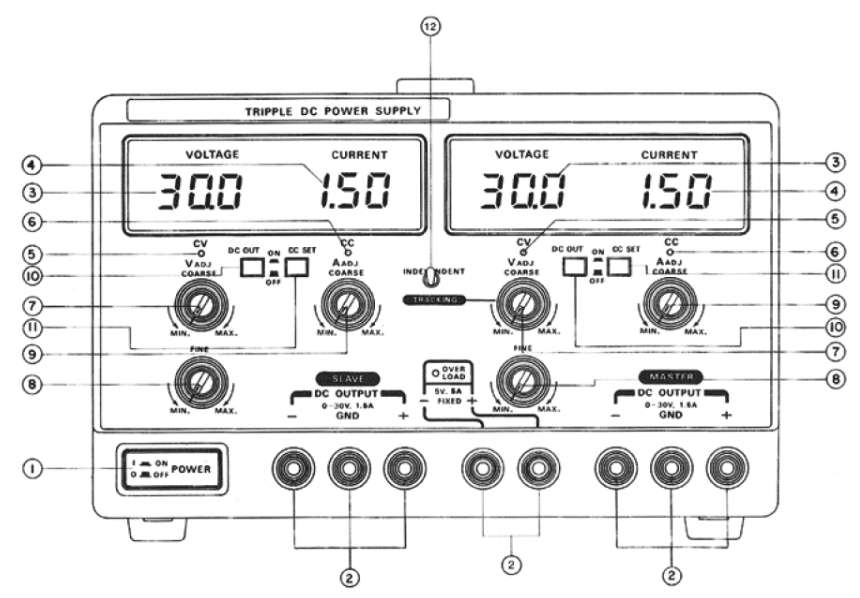
Controls
The main controls for the power supply are:
- Power on/off (1)
- Coarse voltage control (7)
- Fine voltage control (8)
- Coarse current control (9)
Voltage Control
In the shelf of spare electronics parts by your workbench, find a tackle box labeled "LEDs" and take one out.
- Turn on the power supply with nothing connected to it to check the settings.
- Set the voltage on the master side to 1 volt by turning the coarse voltage control down.
- Now check that the DC output is turned off, as you do not want to make connections with the power supply on, it can cause sparks.
- Attach wires from the Master DC OUTPUT with the black wire connect to one end of the LED and the red wire connected to the + plug to the other end of the LED.
- Turn the power supply back on.
- Begin increasing the voltage on the power supply until the LED lights up. If you've passed 4 volts and the LED hasn't lit, back it down to zero volts and reverse the LED before trying again.
- Make a note of the indicated current, for use in the "Current Limit" section below.
- Continue increasing voltage; stop when the LED turns off.
Congratulations, you have now burned out an LED by putting too much voltage through it! Turn down voltage to 1 V, turn off the power supply, and replace the LED.
Current Limit
- Turn off the DC output on the power supply and adjust the coarse current control to be half of the current value recorded during the Voltage limit section.
- Press down the CC Set button to select the current limited mode, the CC light should now be lit.
- Press the DC Out button to turn on the power. The light will be dimmer than before.
- Increase the current limit by adjusting the coarse current control. At some point the value of the measured current will stop increasing even if you turn the coarse current control higher since this only sets the maximum value of the current unlike voltage control which sets the voltage to a fixed level.
Cleanup
- Always turn down the voltage and turn off the output before turning off the main power.
- Gently wind the probes and wires up so there are no tight bends in the wire that could break the wire over time.
- Clean up the table and floor around where you worked.
No Comments