# Crown Stapler
# Manual(s)
*Manuals and other reference materials from the manufacturer or other sources.*
- Model: [Porter Cable NS 100A](https://www.portercable.com/products/power-tools/nailers-and-staplers/specialty-nailers/18-ga-112-in-narrow-crown-stapler-kit/ns150c "https://www.portercable.com/products/power-tools/nailers-and-staplers/specialty-nailers/18-ga-112-in-narrow-crown-stapler-kit/ns150c")
- Manufacturer: [Porter Cable](https://www.portercable.com/ "https://www.portercable.com/")
- Manual: [crown\_stapler-porter\_cable-NS150C.pdf](https://wiki.protohaven.org/attachments/179)
# Member Notes
# Resources
*Where to obtain materials, consumables, and tooling.*
# Tool Tutorial
(Link to PDF Tool Tutorial)
Narrow crown construction staplers are used for cabinets, casebacks, drawers, insulation sheathing, underlayment, molding and trim. Unlike larger staplers designed to go around cables or wire without penetrating, a narrow crown stapler fastens material flush. It is best used on materials softer than hardwoods like oak.
The [Tool Safety](https://www.protohaven.org/wiki/tools/hand_tools/crown_stapler_18ga?s[]=stapler#tool-safety "tools:hand_tools:crown_stapler_18ga ↵"), [Tool Care](https://www.protohaven.org/wiki/tools/hand_tools/crown_stapler_18ga?s[]=stapler#tool-care "tools:hand_tools:crown_stapler_18ga ↵"), [Operation](https://www.protohaven.org/wiki/tools/hand_tools/crown_stapler_18ga?s[]=stapler#operation "tools:hand_tools:crown_stapler_18ga ↵"), section of this guide are what instructors use to ensure that you can use the equipment according to community expectations.
# Requirements
[Crown Stapler](https://protohaven.org/wiki/tools/crown_stapler_18ga "https://protohaven.org/wiki/tools/crown_stapler_18ga") can be used without a clearance.
# Warnings
🚫 Never connect to an air source that is capable of exceeding 175 PSI.
🚫 Only use an air hose that is rated for a maximum working pressure of at least 150 psi (10.3 bar) or 150% of the maximum system pressure, whichever is greater.
🚫 Keep hands and body parts clear of immediate work area.
🚫 Do not drive fasteners near edge of material, on top of other fasteners, at too great of an angle, or with the grain. ⚠️ Wear appropriate PPE.
⚠️ Remove finger from the trigger when not driving fasteners.
⚠️ Disconnect the tool from the air supply when a. Unattended, b. Performing any maintenance or repair, c. Clearing a jam, d. Moving the tool to a new location.
See the [Safety Section](https://www.protohaven.org/wiki/tools/hand_tools/crown_stapler_18ga?s[]=stapler#tool-safety "tools:hand_tools:crown_stapler_18ga ↵") for more information.
# Tool Anatomy
[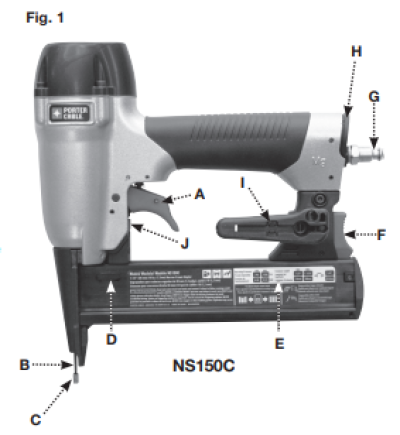](https://www.protohaven.org/wiki/_detail/tools/stapler.png?id=tools%3Ahand_tools%3Acrown_stapler_18ga "tools:stapler.png")
A. Trigger
B. Contact trip
C. No-mar pad
D. Low nail indicator window
E. Magazine
F. Magazine Release
G. Air Inlet
H. Rear exhaust
I. Adjustable belt hook
J. Depth adjustment wheel
For more visit the manufacturers website and user manual both linked at the top of this document.
# Tool Safety
### Personal Protective Equipment
⚠️ Safety glasses, hearing protection, heavy duty gloves, and closed-toed shoes are required.
⚠️ All hair, clothing and accessories should be secured close to the body.
### Common Hazards
**Unintentional Firing**
-
Be sure the trigger is released before connecting to the air supply.
-
Keep fingers away from trigger when not firing.
-
Always assume the tool contains fasteners.
-
When using the bump action trigger, be careful of unintentional double fires resulting from tool recoil. Unwanted fasteners may be driven if the contact trip is allowed to accidentally re-contact the work surface.
-
Do not engage the tool against the work surface with a strong force.
-
Allow the tool to recoil fully after each actuation.
-
Use sequential action trigger.
-
When bump actuating the nailer, always keep tool in control. Inaccurate placement of tool can result in misdirected discharge of a fastener.
-
Drive the nail perpendicular to the grain to reduce risk of unexpected protrusion.
-
Be aware that when the tool is being utilized at pressures on the high end of its operating range, nails can be driven completely through thin or very soft work material. Be aware of material thickness and set depth appropriately.
-
Always disconnect air supply and avoid contact with trigger during depth adjustments.
## Care
Disconnect the tool from the air supply and remove fasteners from magazine before making adjustments or personal injury may result.
##### Daily Maintenance
| Action | Why | How |
|---|
| Drain compressor tanks and hoses daily. | Prevents accumulation of moisture in compressor and nailer. | Open petcocks or other drain valves on compressor tanks. Allow any accumulated water to drain from hoses. |
| Clean magazine, magazine release and contact trip mechanism. | Permits smooth operation of magazine, reduces wear and prevents jams. | Blow clean with compressor air. The use of oils, lubricants periodically or solvents is not recommended as they tend to attract debris. |
| Before each use, check to insure all screws, nuts and fasteners are tight and undamaged. | Prevents jams, leaks and premature failure of tool parts. | Tighten loose screws or other fasteners using the appropriate hex wrench or screwdriver. |
### Set Up
*This nailer is designed to be used without oil.*
1.
Before you use the nailer, be sure that the compressor tanks have been properly drained.
2.
Wear proper eye, hearing and respiratory protection.
3.
Lock the magazine release in the back position and remove all fasteners from the magazine.
4.
Check for smooth and proper operation of contact trip and pusher assemblies. Do not use tool if either assembly is not functioning properly. NEVER use a tool that has the contact trip restrained in the up position.
5.
Check air supply. Ensure that air pressure does not exceed recommended operating limits; 70 to 120 psi, (4.9 to 8.3 bar, 5 to 8.5 kg/cm2).
6.
Connect air hose.
7.
Check for audible leaks around valves and gaskets. Never use a tool that leaks or has damaged parts.
1.
Read all Safety Warnings before using tool.
2.
Connect the tool to air supply.
3.
Push the magazine release (F) and slide magazine (E) to open chamber.
4.
Position nailer on a stable surface so contact trip is pointing upward and away from you.
5.
Insert fasteners into the chamber.
6.
Slide magazine until it clicks, securing the magazine.
-
18 Gauge, 1/2“ – 1-1/2” (12.7 mm – 38.1 mm) length, 1/4“ (6.4 mm) crown staples
-
Update the physical Maintenance Tag at the machine
-
🟢Green can be used without issue
-
🟡Yellow can be used withcaution
-
⛔Red cannot be used without hazard to either the user or the equipment
-
Record issues at [protohaven.org/maintenance](https://protohaven.org/maintenance "https://protohaven.org/maintenance"). This notifies our staff and volunteer maintenance crew of any issues.
### Clearing Jams
NOTE: Should fasteners continue to jam frequently in nosepiece, have tool serviced by an authorized PORTER-CABLE service center.
| Problem | Likely Cause | Potential Solution |
|---|
| Trigger valve housing leaks | O-ring or valve stem failure | Replace valve using: Trigger Valve Kit |
| Top cap leaks air | Loose cap screws | Tighten cap screws using appropriate hex wrench |
| Damaged or worn gasket or o-ring | Replace gasket/o-rings using: O-ring Repair Kit |
| Exhaust leaks | Main seal or o-ring damaged, debris in tool | Replace gasket/o-rings using: O-ring Repair Kit |
| Air leaks around nose when tool is at rest (Driver blade in up position) | Damaged or worn o-rings | Replace gasket/o-rings using: O-ring Repair Kit |
| Air leaks around nose when tool is in actuated position (Driver blade in down position) | Damaged or worn bumper | Replace bumper using: Bumper Kit |
| Tool does not cycle in cold weather | Tool not receiving air | Check air supply |
| Valve may be frozen | Warm up tool |
| Damaged or worn o-rings | Replace gasket/o-rings using: O-ring Repair Kit |
| Broken or damaged driver blade | Replace Driver Blade Kit |
| Lack of power; sluggish | Low air pressure | Check air supply |
| Damaged or worn o-rings | Replace gasket/o-rings using: O-ring Repair Kit |
| Exhaust port blocked or clogged | Disconnect the tool from the air supply, remove exhaust plate from top of tool, clean port |
| Skipping fasteners; intermittent feed | Air restricted | Check air supply and couplers |
| Nosepiece screws loose | Tighten nosepiece screws using appropriate hex wrench |
| Wrong size/angle fasteners | Use only recommended fasteners |
| Dirty magazine | Clean magazine track and nosepiece |
| Worn magazine | Replace magazine |
| Broken or damaged driver blade | Replace Driver Blade Kit |
| Trigger valve o-ring worn or damaged | Replace valve using: Trigger Valve Kit |
| Worn or damaged pusher spring | Replace spring |
| Magazine loose | Check that magazine latch is holding firmly |
| Fasteners jam in tool | Driver channel in nose piece worn | Replace nosepiece |
| Wrong size/angle fasteners | Use only recommended fasteners |
| Magazine loose | Check that magazine screws are holding firmly |
| Worn driver blade | Replace Driver Blade Kit |
| Nosepiece screws loose | Tighten nosepiece screws using appropriate hex wrench |
| Fasteners not feeding properly | Ensure fasteners are feeding properly into nose |